These differences may result from hairstyle, lighting, cosmetic styling, natural changes, or a procedure, but photos alone cannot confirm the cause.
A medical assessment would require scalp examination, donor-density evaluation, and review of any signs of progressive hair loss before drawing conclusions. Hair Transplant Mexico, based in San Pedro Garza García, Monterrey, approaches similar cases by examining the hairline, donor area, and long-term pattern rather than relying on visual comparisons alone.
The sections below explain what the available images can show, what they cannot prove, and how procedures such as FUE could change a comparable hairline.
Key Takeaways
- No public confirmation exists that Mingyu underwent a hair transplant, so claims about a procedure remain speculative.
- Changes in Mingyu’s hairline may reflect styling, lighting, camera angles, or natural variation rather than surgery.
- Public photos cannot reliably diagnose hair loss, measure follicle miniaturization, or confirm graft numbers.
- FUE and DHI can change hairline shape and density, but candidacy depends on donor supply, future hair loss, and medical assessment.
- Confirmed celebrity cases are more useful for comparison than appearance-based rumors because they provide a clearer factual basis.
Did Mingyu Get a Hair Transplant?
No verified public record confirms that Mingyu underwent hair restoration surgery. Hair clinics, entertainment sites, and fan discussions have analyzed his appearance, but they rely mainly on photos taken at different times. Older posts also discussed a possible “hairline revision,” yet they did not provide medical records or a direct statement from him. The procedure therefore remains unconfirmed.
What Has Actually Been Confirmed?
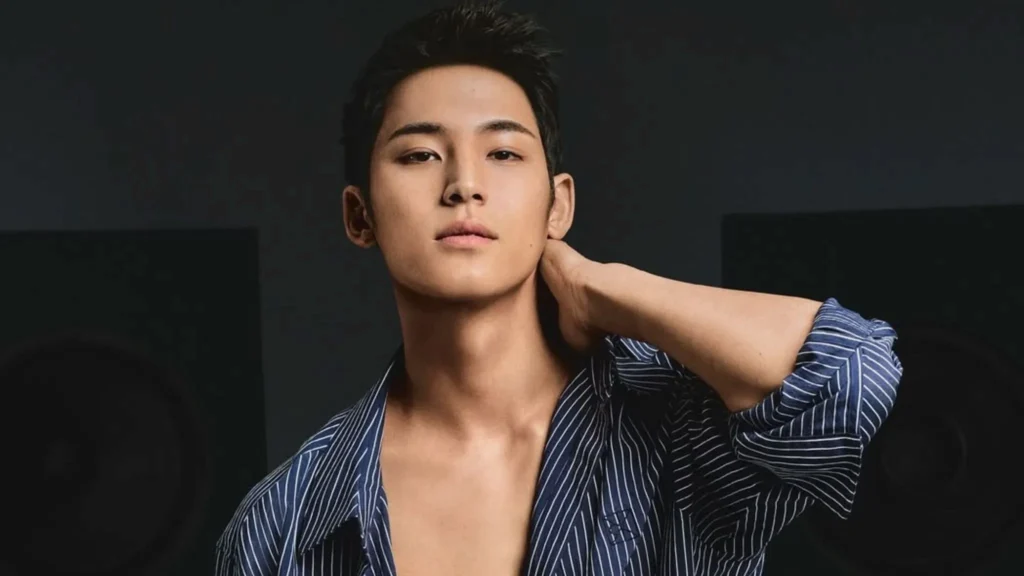
His frontal hairline has appeared different in some photos and performances. Earlier images often show more visible temple curves, while later images sometimes show a straighter frontal border. Styling, makeup, lighting, camera angle, and hair length can affect that appearance. None of those factors prove that follicles were surgically moved.
Mingyu Hair Transplant Before and After
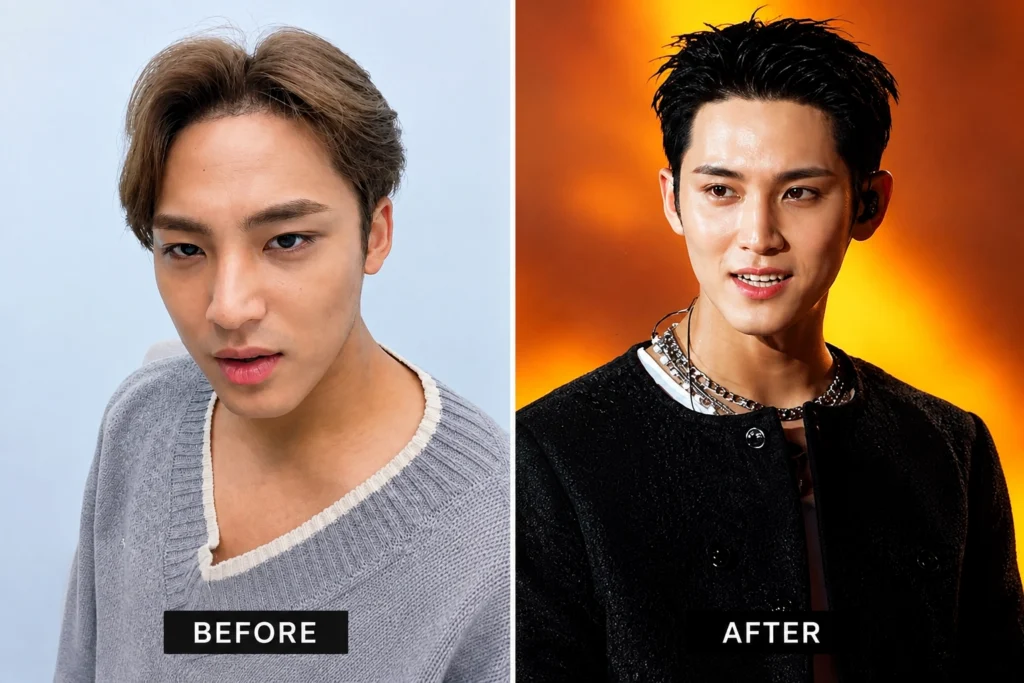
Before-and-after searches usually compare debut-era images with later promotional photos. These comparisons can show differences in shape, temple exposure, and frontal density, but they are not controlled medical comparisons. Images may use different lighting, hairstyles, and resolutions. A reliable clinical assessment requires more than selected photographs.
Mingyu Before Hair Transplant Rumors
Early SEVENTEEN images often show a broad forehead with visible temple angles and dense frontal coverage. Later appearances sometimes show a different frontal outline, especially around the temples and hairline. These differences do not confirm a procedure. It is more accurate to treat the earlier images as a visual reference point rather than as confirmed preoperative photos.
Mingyu’s Recent Hairline
Recent appearances often show strong frontal density and a clean outline when he styles his hair away from his forehead. In other images, the border looks softer, which shows how presentation can change the result. No consistent public sequence shows a documented recovery period or postoperative growth. That limits what can be concluded.
Why Does Mingyu’s Hairline Look Different?
A hairline can look different without any permanent follicle change. Temple coverage, hair direction, and frontal volume can alter the shape of the forehead. Performers also change styling for events, videos, and promotions. The Mingyu hairline discussion should therefore focus on visual observations rather than treating photos as medical evidence.
Hairstyles and Hairline Styling
A fringe can hide the temples, while a slicked-back style exposes the full frontal border. Root-lifting products, hair fibers, or cosmetic products can change how much scalp is visible. Hair color also affects contrast between the scalp and strands. These factors can create a strong before-and-after effect without surgery.
Lighting and Camera Angles
Direct light can make the scalp more visible, while softer light may make the same area look fuller. Camera height and angle can change how much forehead appears in a photo. Wet or separated strands may also make the hair look less dense. These variables make isolated celebrity images poor diagnostic tools.

Does Mingyu Have Hair Loss?
Public images do not provide enough evidence to diagnose Mingyu with male pattern hair loss or another condition. Different temple shapes are not the same as documented progressive recession. A diagnosis requires medical history, a scalp examination, and an assessment of density and follicle miniaturization. You can’t reliably answer the Mingyu hair loss question from public material alone.
What Photos Can and Cannot Show
Photos can show changes in shape, parting, density, and scalp exposure. They cannot reliably show follicle miniaturization, donor density, active shedding, or the cause of a change. They also cannot establish whether someone used medication, cosmetic camouflage, styling, or surgery. Those limits matter when celebrity images are used to discuss treatment.
How Doctors Assess Hair Loss
A physician may review:
- The pattern and duration of thinning
- Donor density and hair caliber
- Miniaturization across the scalp
- Family history and medical causes
- The stability of future hair loss
These findings help determine candidacy and whether another condition should be addressed first. The physician can also discuss donor limits, realistic density, recovery, and long-term planning. This process provides more useful information than trying to copy a celebrity hairline.
How FUE Hair Transplants Work
FUE (follicular unit extraction) removes individual follicular units from a donor area, usually at the back or sides of the scalp, with small punches. The grafts are then implanted where you want added coverage. DHI (direct hair implantation) is an implantation approach that can use an implanter pen to place grafts while controlling direction, angle, and depth.
Understanding the differences between FUE and DHI hair transplant techniques helps explain how extraction and implantation approaches differ. Both depend on donor supply, medical oversight, careful graft handling, and patient factors.
Physician involvement matters because transplantation includes diagnosis, donor planning, anesthesia, extraction, implantation, and postoperative care. Clinics may divide these tasks differently, so patients should ask who performs each step and manages follow-up.
Structured follow-up allows the medical team to assess healing, temporary shedding, new growth, and continued loss in untreated areas. Recovery and final growth vary because anatomy, technique, aftercare, and future thinning differ from patient to patient.
Patients also compare Mexico, Turkey, and the United States when researching surgery. When assessing whether a hair transplant in Mexico is safe, patients should consider physician involvement, clinic oversight, regulatory standards, travel, and access to follow-up.
These factors vary by country, so patients should evaluate the medical team rather than rely on a country label.
San Pedro Garza García is an affluent part of metropolitan Monterrey with substantial medical and commercial infrastructure. For international patients, consider value alongside continuity of care, informed consent, and access to the treating physician.
How Hairlines Are Designed
Hairline design considers facial proportions, age, existing density, donor supply, and expected future loss. Surgeons plan the direction and angle of grafts so the frontal border does not look like a uniform row. A lower or straighter line is not appropriate for every patient. Native strands behind the treated area may continue to thin, so long-term planning matters.
Why Graft Counts Cannot Be Confirmed
Some online articles estimate how many grafts Mingyu may have received, but those numbers are hypothetical. Requirements depend on the treatment area, existing density, hair caliber, donor supply, and hairs per follicular unit. Photos cannot measure these variables accurately enough to verify a number. A precise estimate for an unconfirmed procedure can create false certainty.
Which Celebrities Have Hair Transplants?
Celebrity examples are most useful when the person has confirmed the procedure. Public confirmation separates documented cases from appearance-based rumors. A changed hairline alone does not prove surgery.
Other public figures have generated similar discussions, including UFC fighter Merab Dvalishvili, whose hair transplant has been discussed alongside changes in his appearance.
Korean Actors With Confirmed Procedures
Confirmed cases among Korean actors are less common than online rumor lists suggest. Park Hae-soo was reported in 2026 to have attributed his changed appearance to a hair transplant, while many other actors and idols remain subjects of speculation.
Korean performer Park Seo-jin has also publicly discussed receiving a hair transplant, although he is primarily known as a singer and television personality. These examples show why the source of a claim matters more than a before-and-after collage.
If you are concerned about changes in your hairline or density, a medical evaluation can help identify the cause and clarify your options. You can schedule a consultation with Hair Transplant Mexico for a personalized assessment.